
How to Choose the Right Drone Detector?

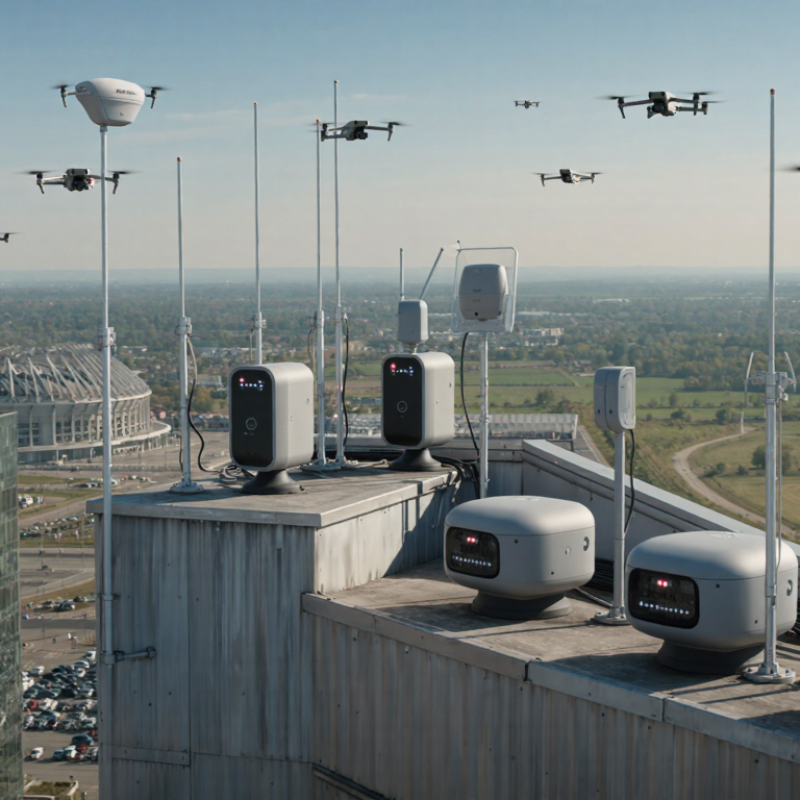
Choosing the right Drone Detector begins with understanding the environment, not simply comparing product prices. Airports, warehouses, stadiums, and critical infrastructure face different detection challenges. A quiet rural site may require long-range radio-frequency monitoring. An urban venue may need stronger filtering against Wi-Fi, vehicles, and dense signal traffic. The physical scene matters.

Industry data shows why this decision deserves careful research. The Federal Aviation Administration has reported more than 780,000 drones registered in the United States, including recreational and commercial aircraft. That expanding fleet increases the need for reliable situational awareness. MarketsandMarkets estimates that the global counter-UAS market will grow substantially through 2028, driven by security, infrastructure, and public-safety requirements. These figures indicate momentum, but market forecasts are not product guarantees. They should be treated as direction, not proof.

A professional evaluation should examine detection range, frequency coverage, false-alarm control, weather resistance, software quality, and integration options. Ask how the device performs near cellular towers, metal buildings, trees, and moving vehicles. Request independent testing data, not only laboratory claims. Check whether the system identifies drone signals, flight patterns, or both. That distinction can affect response speed.

No detector is perfect. Signal-reflective buildings can create blind spots. Autonomous aircraft may produce limited radio emissions. Human review still matters. This guide compares the practical criteria behind a dependable Drone Detector, helping readers match technology with site risks, operating conditions, and responsible security procedures. The best choice is rarely the loudest specification sheet. It is the system that performs consistently when the surroundings become complicated.
How to Choose the Right Drone Detector?

Define the Detection Mission: Coverage, Threats, and Response Time

Choosing the right drone detector begins with the mission, not the product features. In field assessments, I map the protected area before comparing specifications. A small warehouse needs different coverage from a large perimeter. Mark rooftops, loading gates, parking areas, and blind corners. Measure expected ranges, elevation, and terrain. A detector should cover important approach paths, not just display an impressive range on paper. Wider coverage can also create more nuisance alerts.

Define threats in observable terms. Consider drone size, speed, altitude, and operating patterns. Do you need to identify one aircraft or distinguish it from birds, weather, and nearby equipment? Ask what evidence operators require: location, direction, time, and confidence level. Use more than one sensor type when conditions change. Radio-based detection may struggle around dense structures, while radar often requires careful tuning. No sensor is perfect.

Response time must match the real consequence. A facility with valuable equipment may need alerts within seconds, while a remote site may accept slower confirmation. Set practical stages: detect, verify, notify, and record. Test during daylight, darkness, rain, and heavy radio traffic. Keep a response log. It reveals delays that brochures hide. I have seen teams overvalue maximum range and overlook staffing. That mistake is common. A technically strong system can fail when nobody owns the alert. Review thresholds after real exercises, because the first configuration is rarely right.


Match Sensors to Drone Signals: 2.4 GHz, 5.8 GHz, Radar, and RF

How to Choose the Right Drone Detector?

Match Sensors to Drone Signals: 2.4 GHz, 5.8 GHz, Radar, and RF

Choosing a drone detector starts with understanding the signals around your site. The 2.4 GHz band often supports control links, telemetry, and wireless video. The 5.8 GHz band commonly carries high-bandwidth video. A detector covering both bands can identify more activity, but interference from Wi-Fi may create false alerts. A quiet warehouse differs from a crowded stadium.

Radar adds another layer. It detects movement, distance, direction, and sometimes altitude, even when a drone transmits weakly. This matters near trees, walls, or changing light. However, small drones can appear as difficult targets, especially during rain or heavy background movement. Radar is not magic. Placement and calibration matter greatly.

RF sensing can recognize radio emissions and support protocol analysis without relying on visible contact. It may help classify signal patterns, but encrypted or unfamiliar links can reduce confidence. Combining RF with radar usually improves verification. Look for adjustable thresholds, event logs, time-stamped evidence, and clear operator alerts. Test the system with permitted equipment in the actual environment. Metal roofs, nearby transmitters, and rotating machinery can change results. My own preference is conservative alerting, although that may miss a brief event. A detector that explains uncertainty is often more trustworthy than one claiming perfect identification.

Compare Detection Methods: RF, Radar, EO/IR, and Acoustic Sensing

How to Choose the Right Drone Detector?

Detection begins with the signal a drone leaves behind. The CISA Counter-UAS Technology Guide (2023) identifies radio-frequency, radar, electro-optical/infrared, and acoustic sensing as distinct detection approaches. RF sensors can identify control links and telemetry across wide areas. They are fast and relatively discreet. However, autonomous flights may produce little detectable radio traffic. RF results also suffer near dense wireless networks. A quiet screen is not proof of an empty sky.

Radar measures movement, range, altitude, and direction. It works in darkness and moderate rain, making it valuable around large facilities. The same sensor may confuse birds, cranes, or fast-moving debris. The National Academies’ 2024 report on counter-drone technologies stresses that classification remains harder than initial detection. That distinction matters. A track is not an identity.

EO/IR cameras add visual confirmation. Daylight cameras reveal shape and payload details, while thermal imaging supports night observation. Fog, glare, and small targets can reduce confidence. Acoustic arrays listen for propeller signatures and can support short-range detection. They are useful near quiet perimeters, but wind, machinery, and traffic quickly raise the noise floor. The European Union Aviation Safety Agency’s 2023 drone safety review notes that operating environments strongly affect system performance. Real deployments need layered sensing, calibrated alerts, and human review. More sensors can also create more false alarms. That uncomfortable trade-off deserves testing before purchase.

Verify Remote ID Compatibility Under the FAA’s September 2023 Rule

How to Choose the Right Drone Detector?

Under the FAA’s September 16, 2023 Remote ID rule, many drones must broadcast identification and location data during flight. The FAA Aerospace Forecast FY 2024–2044 reports more than 850,000 registered drones in the United States. That volume makes passive detection increasingly important. A suitable detector should decode ASTM F3411-22a Remote ID messages, not merely sense radio activity. Confirm support for drone identification, latitude, longitude, altitude, velocity, and control-station location.

Do not trust a green status light. Ask for a live decoding demonstration. Place the detector near a launch area, then compare its displayed coordinates with a verified map position. Check whether it receives both standard Remote ID and broadcast modules. The FAA allows certain operations inside FAA-Recognized Identification Areas, so a missing broadcast does not automatically prove noncompliance. Verify the current area list and operating conditions before judging an alert.

Data quality matters more than detection range claims. The FAA’s UAS Identification and Tracking Aviation Rulemaking Committee emphasized reliable identification and location reporting for safety operations. Look for timestamped logs, signal-strength records, firmware update procedures, and exportable evidence. Test performance beside buildings, trees, and moving vehicles. Results may change. My own checklist would not rely on one afternoon test, because interference and weather can distort conclusions. A detector that identifies a signal but cannot preserve readable evidence may create confidence without useful verification.

Select by Measurable Specs: Range, False Alarms, Latency, and Uptime

Choosing a drone detector starts with measurable evidence, not an impressive brochure. CISA’s Counter-UAS Technology Guide identifies detection range, probability of detection, false-alarm rate, and latency as core evaluation measures. Ask for range results across height, weather, terrain, and radio congestion. A five-kilometre claim means little if trees or buildings reduce coverage. Request test logs, not one maximum-distance number. Measure detection probability separately from classification accuracy. That distinction matters. A 95 percent detection rate can still miss one aircraft in twenty. Use controlled, lawful test flights and independent observers. Do not accept vendor-selected routes only.

False alarms deserve equal weight. Record alerts per hour, square kilometre, weather condition, and operating shift. Latency should cover the complete path, from sensor detection to operator display. For time-sensitive safety decisions, ten seconds differs sharply from one second. Use the 95th-percentile result, not an average that hides delays. Uptime needs evidence too. A 99.9 percent target still allows about 8.8 hours of annual downtime. Uptime Institute’s Annual Outage Analysis supports separating outage frequency, duration, and operational impact. Require 30- or 90-day logs, restart events, maintenance windows, and battery history. The uncomfortable question is whether performance survives the actual site. Many evaluations do not test enough. That weakness belongs in the procurement record.

How to Choose the Right Drone Detector?

Select by measurable specifications: detection range, false alarms, alert latency, and system uptime.

The chart shows practical reference targets for a perimeter-security deployment: at least 5 km detection range, no more than 0.5 false alarms per hour, alert latency of 1 second or less, and 99.9% availability. Actual requirements should be validated through site testing, spectrum conditions, terrain, weather, and local regulations.