
A Rail Web Broadband Damper is a vibration-control device fitted to the web of a railway rail. The rail web is the vertical steel section between the head and foot. It can vibrate when wheels pass over joints, switches, welds, or irregular track surfaces. These vibrations may create rolling noise, structural resonance, and uncomfortable sound inside nearby buildings.
Unlike a narrow-band tuned damper, a Rail Web Broadband Damper targets a wider range of frequencies. It usually combines resilient materials, constrained layers, or carefully designed masses. These elements absorb part of the rail’s vibrational energy. The result can be quieter track and reduced vibration transmission. Performance depends on rail geometry, fastening stiffness, train speed, temperature, and installation quality.
Railway noise specialist Dr. David Thompson has expressed a useful engineering principle: “Railway vibration control must be considered as a system problem, not only a component problem.” This principle matters here. A damper cannot correct poor grinding, weak fasteners, or damaged rail surfaces. Field measurements remain essential.
Small details matter.
Engineers may compare acceleration levels before and after installation. They may also inspect clips, pads, bolts, and contact surfaces beside the track. Results can vary between curves, bridges, tunnels, and open ballast sections. The term “broadband” can also be used inconsistently across suppliers. That deserves careful review. This article explains the structure, operating mechanism, applications, testing methods, and practical limitations of the Rail Web Broadband Damper. It also considers where expectations may exceed real-world performance.
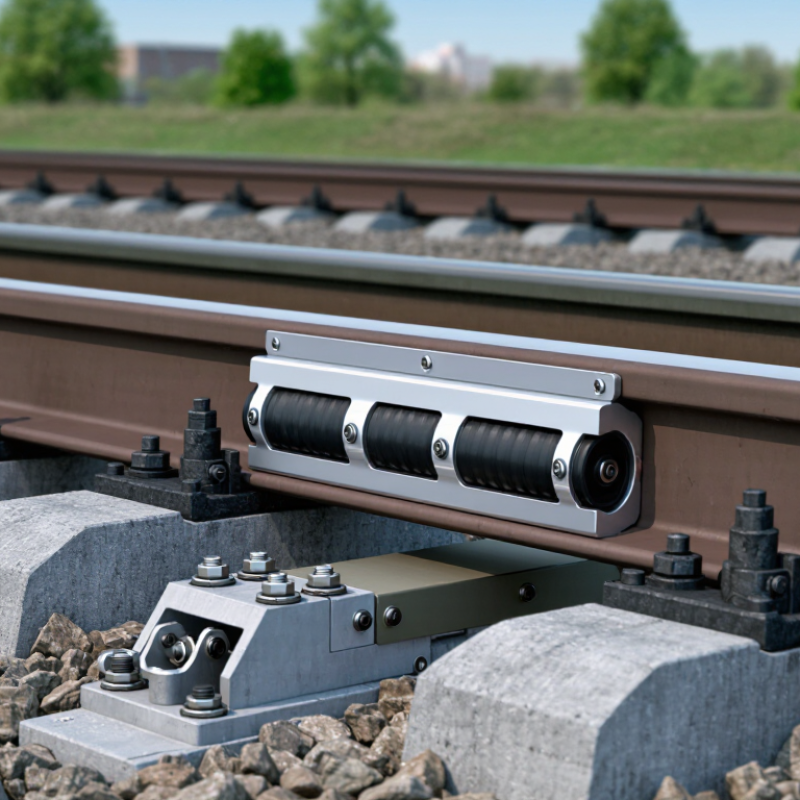
A rail web broadband damper is a vibration-control device fitted to the rail web, the vertical section between the head and foot. Its structure commonly includes a damping mass, resilient material, and a clamp or bonded attachment. Some designs use layered elastomers or metal elements. These parts move slightly when the rail vibrates, converting mechanical energy into heat.
“Rail web” identifies the mounting location. “Broadband” means the device targets a wide range of vibration frequencies, rather than one narrow resonance. “Damper” describes its energy-dissipating function. The term can vary between technical documents, so it should not be confused with a rail pad, fastening component, or acoustic barrier. In field work, engineers should check drawings, installation details, and measured vibration data. A familiar name does not always indicate identical construction.
Tips: Inspect the web surface before installation. Remove loose contamination, check clamp pressure, and confirm clearances near fasteners. Record temperature and rail condition during testing. Results may change with wheel condition, track stiffness, and train speed. That part is easy to overlook. The most useful assessment combines visual inspection with frequency-based measurements, although measurement quality can still be imperfect. A damper that appears secure may not be working effectively. Recheck it after traffic exposure.

A rail web broadband damper is a passive device fixed to the rail web, the narrow section between the head and foot. It reduces structural vibration across a broad frequency range, rather than targeting one precise resonance. In practice, wheel–rail contact excites the rail head first. That energy then travels downward through the web, where bending and shear motion develop. Between 500 and 2,000 Hz, these movements can become especially noticeable near joints, switches, or rough contact patches.
A train wheel may create a short, sharp force when it meets a small surface irregularity. The rail head responds quickly, then transfers vibration through the web like a steel bridge carrying repeated pulses. The damper moves with the web and dissipates part of that energy through its internal material. Less energy returns along the rail, and nearby components may radiate less structure-borne noise. The result is not silence. It is usually a lower vibration level and a shorter decay time.
Field assessment should combine accelerometers, controlled impact tests, and measurements during real train passages. A single frequency plot can mislead. Broadband performance is rarely perfectly uniform, especially when fastening stiffness, temperature, and rail condition change. I have found that installation contact matters more than expected. A small gap, loose fixing, or contaminated surface can weaken the damping effect. The frequency range also deserves caution; 500–2,000 Hz is useful, but actual wheel–rail behavior may extend beyond it. Engineering judgment remains necessary.
A rail web broadband damper is fitted to the vertical web between the rail head and foot. It reduces vibration across a wide frequency range. The device usually combines a stiff outer layer with a viscoelastic material. When the rail bends, both layers move differently. This movement creates shear inside the viscoelastic layer.
Shear deformation is the key process. It forces polymer chains to move and recover repeatedly. Internal friction then changes part of the vibration energy into a small amount of heat. The rail keeps carrying wheel loads, while less energy travels through the steel. The result can include lower noise, reduced structure-borne vibration, and less rattling in nearby components.
The word broadband can mislead. No damper works equally well at every frequency. Its performance depends on temperature, train speed, bonding quality, and rail vibration modes. In field inspections, loose edges or poor surface preparation often reduce effectiveness. Engineers should check dynamic measurements before and after installation, rather than trusting a catalogue curve alone. I would also question results collected during only one season. Viscoelastic materials can become stiffer in cold weather and softer in heat. Small details matter.
A rail web broadband damper is a tuned device fixed to the rail web. It reduces vibration across a broad frequency range. When a wheel rolls over the rail, steel vibration can radiate airborne noise. The damper adds controlled mass and energy dissipation. In practical terms, it makes the rail less acoustically active. Installation quality matters greatly. A loose fastener can distort the result.
A 3–8 dB(A) claim should come from controlled pass-by measurements, not a single trackside impression. ISO 3095 provides a framework for measuring railway noise during vehicle operation. Engineers normally record A-weighted sound levels with calibrated microphones beside the track. They also document train speed, vehicle type, rail condition, wheel condition, weather, and microphone position. Several comparable runs are needed.
The reduction is calculated against a suitable untreated reference. Ideally, both conditions use the same vehicles, track section, and operating speed. A 3 dB(A) change may be measurable but difficult to notice consistently. An 8 dB(A) result is more substantial, yet it still depends on test conditions. Ground reflections, wheel roughness, and background noise can shift the outcome. Field work is rarely perfect. I would report uncertainty, sample size, and raw levels, rather than presenting one impressive number. Evaluation after installation should also check whether performance remains stable through seasonal wear and maintenance.
How Installation, Rail Profiles, and Temperature Affect Damper Performance
A rail web broadband damper is a resilient device fitted to the rail web. It reduces vibration across a wide range of frequencies. In practice, performance depends on more than the damper’s rated properties. Contact quality matters greatly. Dirt, rust scale, or uneven surfaces can create small gaps and weaken energy transfer. The rail web should be inspected, cleaned, and measured before installation. Fasteners must receive controlled torque, not a rough estimate.
Rail profiles also influence the result. A damper designed for one web shape may sit poorly on another. Curvature, web thickness, and nearby clips can change its stiffness and movement. Field inspections often reveal alignment problems near joints and switches. These areas deserve extra checking. A neat installation can still underperform.
Temperature brings another variable. Rubber and polymer components usually become stiffer in cold weather and softer in heat. This changes how they absorb rail vibration. Seasonal measurements can expose performance differences that a single test misses. Track temperature, not only air temperature, should be recorded.
I have seen installations judged too quickly after mild weather. That approach seems convenient, but it can hide real operating limits. Long-term inspections should check bolt condition, material aging, and movement marks on the rail web. Small marks may reveal large problems.
Precision Cable Assemblies
16830 Pheasant Drive
Brookfield, WI 53005
Phone: 262-784-7887
Fax: 262-784-0681